Bidding Special Electrical Systems Over 600 Volts Under OSHA 1926.408
When trade subcontractors and estimators review contract documents involving temporary distribution, large mobile plant machinery, or high-capacity infrastructure, understanding electrical boundaries is critical. Temporary and permanent power networks operating above standard utility branch lines bring strict federal requirements. Under OSHA 29 CFR 1926.408, special electrical systems operating at over 600 volts nominal, along with specialized signaling and communication lines, carry defined installation and guarding rules that must be coordinated with the general contractor before submitting a bid.
What High-Voltage Wiring Methods Must Subcontractors Verify with the GC?
For installations operating at over 600 volts nominal, general wiring methods cannot follow standard low-voltage practices. Estimators should confirm who supplies, protects, and supports above-ground and underground transitions during construction phases. According to 29 CFR 1926.408(a)(1), above-ground fixed installations require specific raceways or cable types:
- Above-ground conductors must run in rigid metal conduit, intermediate metal conduit, cable trays, cablebus, other suitable raceways, or open runs of metal-clad cable designed for that use.
- Open runs of bare conductors, busbars, or non-metallic-sheathed cable are restricted to locations accessible only to qualified persons.
- Metallic shielding parts, including braids, tapes, or wires on conductors, must be grounded.
- Open runs of insulated cables or wires with bare lead sheaths or braided outer coverings require support designed to stop physical damage to the coverings.
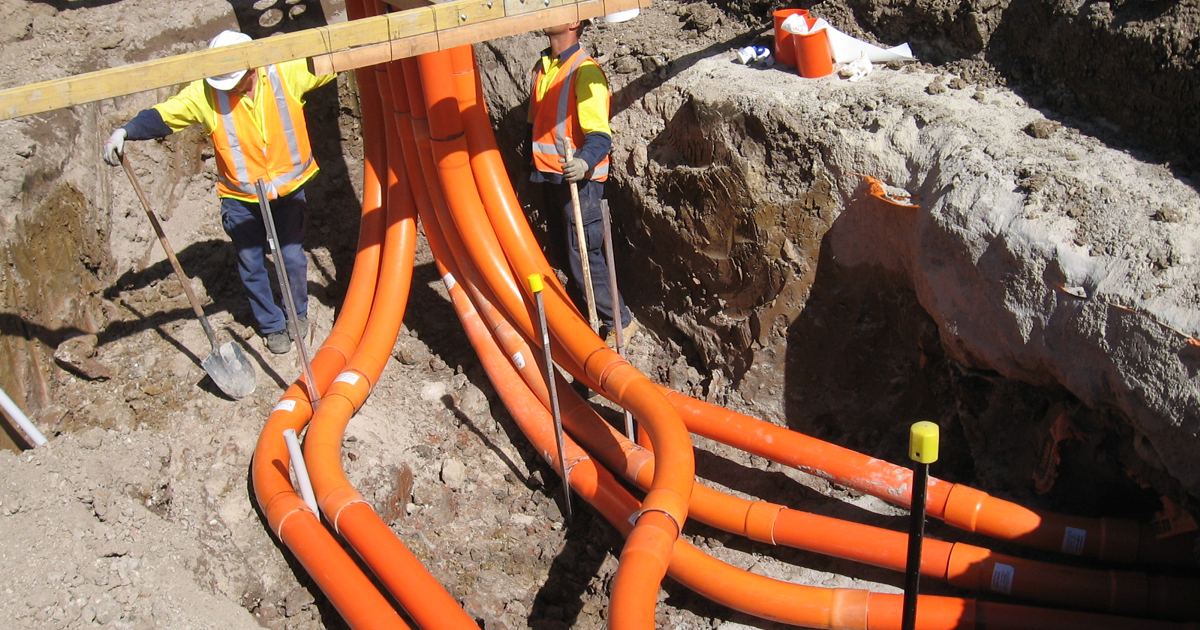
- Conductors emerging from the ground must be enclosed in raceways; when installed on poles, rigid metal conduit, intermediate metal conduit, or Schedule 80 PVC (or equivalent) must extend from the ground line up to 8 feet (2.44 m) above finished grade.
- Conductors entering buildings must have protective enclosures extending from the ground line to the entrance point, and metallic enclosures must be grounded.
Clarifying these demarcation points with the general contractor helps teams write clear bid exclusions and clarifications regarding who installs heavy physical protection at grade transitions.
How Must Over-600-Volt Circuit Breakers and Isolating Devices Be Handled?
Indoor interrupting devices and equipment disconnects require strict physical separation and warning mechanisms to prevent accidental operation under load. Indoor circuit breakers must consist of metal-enclosed units or fire-resistant, cell-mounted units, though open mounting is permitted in spaces accessible solely to qualified personnel. Every circuit breaker installation must include a direct means to indicate whether it is in the open or closed position.
Fused cutouts installed in buildings or transformer vaults must be specifically identified for that purpose and remain readily accessible for fuse replacement. In addition, an isolating means must be provided to completely isolate equipment for inspection and repair. If an isolating device is not engineered to interrupt the circuit's load current, the standard mandates that it must either be interlocked with an approved circuit interrupter or posted with an explicit sign warning against opening the device while under load.
What Controls Are Required for High-Voltage Mobile Gear and Tunnels?
Heavy civil and underground projects frequently employ high-voltage equipment, such as excavators, draglines, hoists, pumps, and mobile substations. Subcontractors bidding on these environments must verify that mobile machinery connections and tunnel networks satisfy mandatory guarding and bonding rules:
- Mobile Machine Terminations: Mobile machines require a metallic enclosure for power cable terminals, fitted with a solid grounding connection to the machine frame. The cable termination must prevent physical pulling or strain from transferring stress to the electrical connections.
- Enclosure Security: Switching and control parts must be housed in grounded metal enclosures with locks accessible only to authorized qualified persons, labeled with warning signs for energized parts, and built with operating handles projecting outside so circuit breakers can be reset without opening locked doors.
- Revolving Machine Guarding: Collector ring assemblies on revolving equipment like draglines and shovels must be guarded.
- Tunnel Disconnects and Conductors: High-voltage tunnel conductors must be Type MC cable, metal conduit or raceway, or suitable multiconductor cable, containing an insulated or bare equipment grounding conductor. A disconnecting means that simultaneously opens all ungrounded conductors must be placed at every transformer or motor location.
- Tunnel Bonding Spacing: All nonenergized metal equipment parts, raceways, and cable sheaths in tunnels must be grounded and bonded to all metal pipes and rails at the portal and at intervals not exceeding 1000 feet (305 m).
How Do Class 1, Class 2, and Class 3 Power-Limited Circuits Differ?
Control systems, signaling wiring, and remote-control circuits on commercial jobsites fall into distinct power tiers under 29 CFR 1926.408(b). Class 1 power-limited circuits are supplied by sources rated at not more than 30 volts and 1000 volt-amperes, while Class 1 remote control and signaling circuits may run up to 600 volts without mandatory source power output limits.
Class 2 and Class 3 circuits rely on inherent power limitation or a combination of power supply and overcurrent protection. Inherently limited sources have maximum circuit limits of 150 volts AC or DC for Class 2, and 100 volts AC or DC for Class 3. Where limited by overcurrent protection, maximum circuit voltages are 30 volts AC and 60 volts DC for Class 2, and 150 volts AC or DC for Class 3. Power supply units for Class 2 or Class 3 circuits must be durably and visibly marked with their class and electrical rating before jobsite use.
What Separation and Clearance Rules Apply to Communications Wiring?
Site communications systems—including telephone circuits, radio equipment, and outside wiring for central station fire and burglar alarms—are exempt from several general temporary wiring sections but must maintain physical separation from light and power conductors. Outside building drops must avoid contact with power lines, and lead-in conductors must maintain at least 6 feet (1.83 m) of clearance from lightning protection conductors. When attached to poles, communications wiring must sit below power conductors and cannot share a crossarm carrying light or power circuits.
Inside buildings, open communication lines, antennas, and lead-ins must maintain a separation of at least 2 inches (50.8 mm) from conductors of light, power, or Class 1 circuits unless an approved, equally protective separation method is used. If communication circuits run where accidental contact with power conductors operating above 300 volts is possible, approved protectors must be installed. Outdoor antenna structures must be located far enough from power lines carrying over 150 volts to ground to avoid accidental contact if the structure falls, and antenna masts must be permanently grounded without splices in the grounding conductor.
Sources
Published October 30, 2026. No affiliate links on this page. Facts come from the sources linked above; check them for updates.