Formaldehyde Rules: Exposure and Control Mistakes to Avoid
Occupational exposure to formaldehyde (chemical substance HCHO, Chemical Abstracts Service Registry No. 50-00-0) occurs from airborne gas, chemical solutions, and materials that release formaldehyde. Under 29 CFR 1910.1048, employers face specific requirements regarding airborne thresholds, mandatory sampling, engineering safeguards, and protective gear. Misinterpreting these regulations exposes workers to health hazards and creates significant bid and operational risks for trade contractors. Below are six critical mistakes contractors make when handling formaldehyde requirements on the job.
Failing to Distinguish the Action Level from Permissible Exposure Limits
A frequent error is treating the action level as if it were the ceiling for permissible exposure. Under 29 CFR 1910.1048, the standard establishes distinct airborne benchmarks:
- Action Level: An airborne level of 0.5 parts formaldehyde per million parts of air (0.5 ppm), measured as an 8-hour time-weighted average (TWA).
- Permissible Exposure Limit (PEL) TWA: An 8-hour TWA ceiling of 0.75 parts formaldehyde per million parts of air (0.75 ppm).
- Short Term Exposure Limit (STEL): An exposure cap of 2 parts formaldehyde per million parts of air (2 ppm) over a 15-minute period.
Crossing the action level triggers obligations such as periodic testing, medical examinations, and potential operational adjustments long before airborne levels breach the 8-hour PEL of 0.75 ppm. Estimators and safety managers who only evaluate jobsite conditions against the PEL overlook the lower 0.5 ppm trigger that activates formal compliance duties.
Skipping Exposure Monitoring Without Objective Data
Employers sometimes assume they can forgo air monitoring simply because their work occurs in an open layout or involves standard interior materials. Under 29 CFR 1910.1048, monitoring is required unless an employer documents an exception using objective data. To bypass air sampling, the employer must document that formaldehyde-releasing materials cannot produce airborne concentrations at or above the 0.5 ppm action level or the 2 ppm STEL under foreseeable conditions of use.
Initial monitoring requires identifying all employees who may be exposed at or above the action level or STEL, using full-shift or short-term representative sampling across each job classification and workshift. Furthermore, initial monitoring cannot be treated as a single event. Employers must repeat sampling whenever modifications in equipment, processes, production, personnel, or control measures introduce new or higher exposures, or whenever workers report respiratory or dermal symptoms tied to formaldehyde.
Misjudging Periodic Sampling Intervals and Termination Rules
Failing to maintain mandatory sampling schedules is another recurring compliance trap. When initial testing identifies employee exposure at or above the 0.5 ppm action level, the employer must repeat air monitoring at least every 6 months. If testing shows exposure at or above the 2 ppm STEL, monitoring must take place at least once a year under worst conditions.
Monitoring methods must maintain documented precision at a 95 percent confidence level:
- Within plus or minus 25 percent for concentrations at the TWA and STEL.
- Within plus or minus 35 percent for concentrations at the 0.5 ppm action level.
Contractors also encounter problems when attempting to terminate periodic sampling too quickly. Discontinuing periodic monitoring is only permitted after two consecutive sampling events conducted at least 7 days apart show airborne levels below both the action level and the STEL. Results must also be delivered to affected personnel in writing or posted within 15 working days of receipt.
Neglecting Regulated Areas and Multiemployer Site Communication
When airborne concentrations exceed either the 0.75 ppm TWA or the 2 ppm STEL, the employer must establish a regulated area. Many trade contractors fail to secure and sign these spaces properly. Entrances and access ways must be posted with warning signs that state "DANGER / FORMALDEHYDE" along with warnings that it "MAY CAUSE CANCER" and causes skin, eye, and respiratory irritation, restricted to "AUTHORIZED PERSONNEL ONLY."
Access is confined strictly to authorized persons who have received training on formaldehyde hazards. Furthermore, on multiemployer worksites, any employer establishing a regulated area must inform other employers on-site about the specific locations and access limitations to prevent neighboring trade crews from entering uncontrolled spaces.
Substituting Respirators for Feasible Engineering Controls
Another serious pitfall is issuing respirators as a default fix rather than implementing engineering controls and work practices. Under 29 CFR 1910.1048, employers must first institute engineering controls and work practice adjustments to lower exposures to or below 0.75 ppm TWA and 2 ppm STEL. Respirators may only supplement controls when engineering measures are not feasible, while controls are being installed, when controls prove insufficient, or during emergencies.
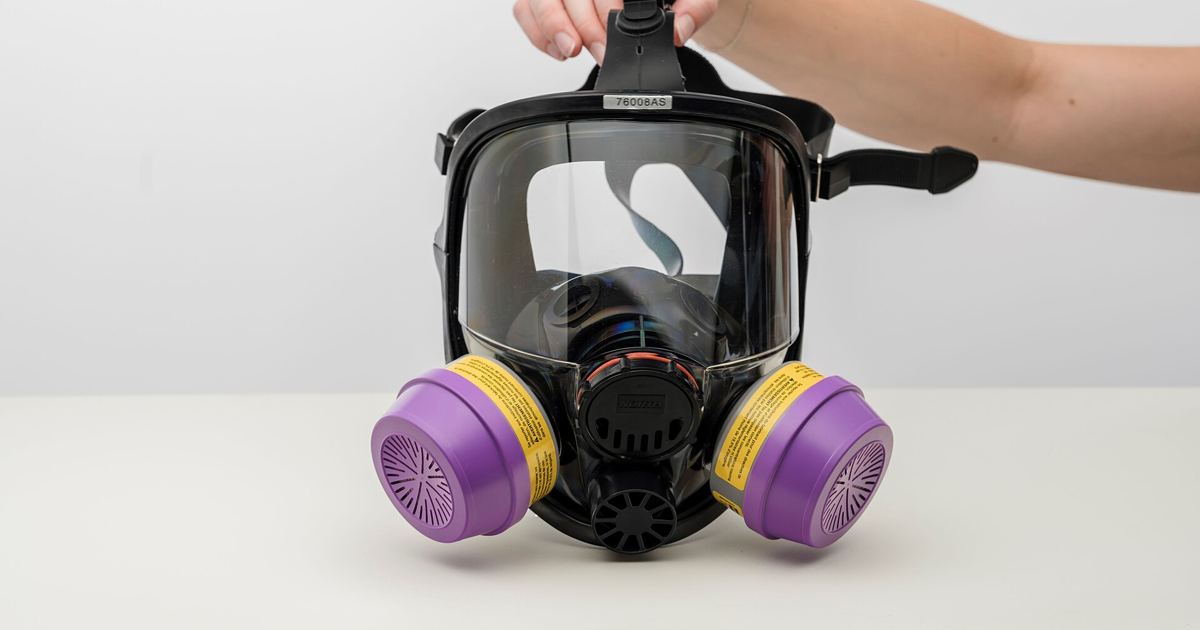
When respirators are mandated, employers must run a program adhering to 29 CFR 1910.134 (for background on program setup, see our guide to Respiratory Protection Programs: What OSHA Expects on Job Sites). Air-purifying respirators must use canisters or cartridges approved for formaldehyde. If cartridges lack NIOSH-approved end-of-service-life indicators, the employer must replace them at the conclusion of the workshift or in accordance with 29 CFR 1910.134, whichever comes first. If an employer equips personnel with an air-purifying half mask rather than a full facepiece, the half mask must be paired with effective gas-proof goggles.
Overlooking Skin and Eye PPE for Chemical Solutions
Liquid formaldehyde mixtures present severe chemical contact hazards that basic dust protection will not address. Employers must supply appropriate protective clothing and equipment at no cost to workers under 29 CFR 1910.132 and 29 CFR 1910.133.
Workers must prevent all eye and skin contact with liquids containing 1 percent or more formaldehyde by wearing impervious chemical protective clothing along with goggles or face shields. If a face shield is selected, chemical safety goggles must also be used whenever chemical contact with the eye area is possible. Full body protection becomes mandatory if workers enter work areas exceeding 100 ppm or during emergency reentry when concentrations remain unknown.
Contaminated equipment and clothing require designated, ventilated storage areas with warning signs, and containers must be labeled consistent with the Hazard Communication Standard. Contaminated items must never be taken home by employees, and only trained personnel may handle their laundering, cleaning, or disposal.
Sources
Published October 31, 2026. No affiliate links on this page. Facts come from the sources linked above; check them for updates.