OSHA 29 CFR 1926.406: Jobsite Electrical Equipment Guide
Construction projects often require specialized, high-demand machinery that goes beyond standard temporary power cords and basic branch circuits. Federal safety regulations set distinct wiring, switch, and clearance requirements for specific-purpose gear under OSHA 29 CFR 1926.406. For general contractors, interior specialty subcontractors, and project estimators planning layout logistics and power supply hookups, understanding these rules prevents compliance oversights and hazardous field installations.
Crane and Hoist Disconnect Configurations
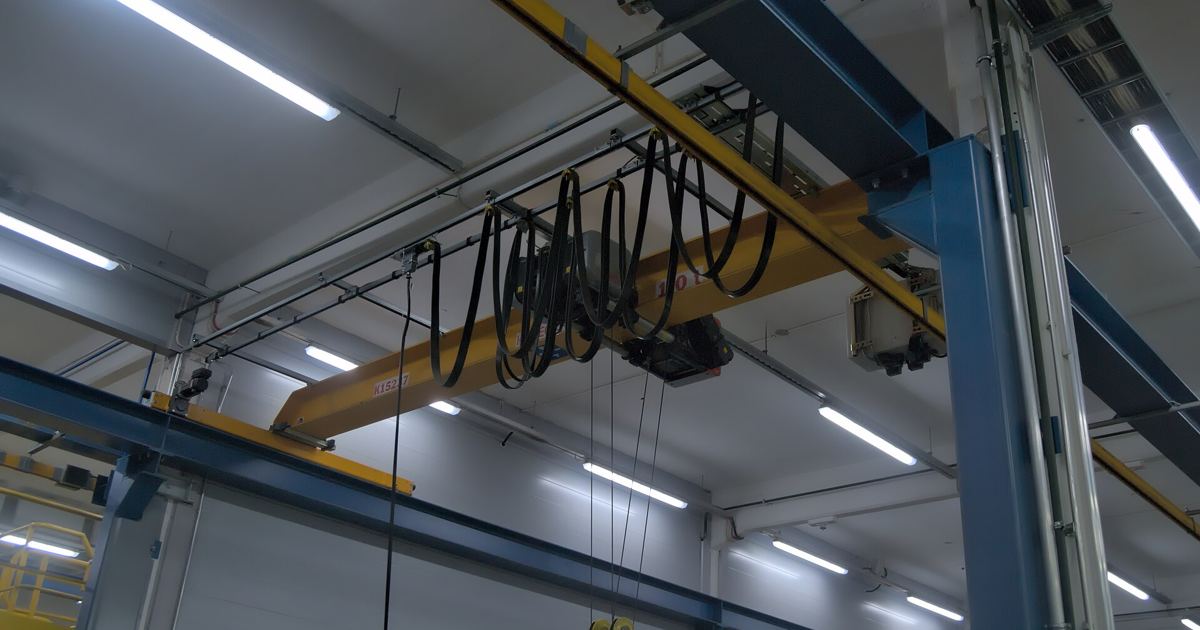
The standard covers the electric equipment and wiring used in connection with cranes, monorail hoists, hoists, and all runways. When planning power supplies for this equipment, contractors must install a readily accessible disconnecting means between the runway contact conductors and the power supply.
In addition, a disconnecting means capable of being locked in the open position must be provided in the leads from the runway contact conductors or other power supply on any crane or monorail hoist. If this disconnect is not readily accessible from the operating station, the installation must provide a means at the operating station to open the power circuit to all motors. However, this additional disconnect may be omitted entirely if a monorail hoist or hand-propelled crane bridge installation satisfies three conditions:
- The unit is floor controlled;
- The unit is within view of the power supply disconnecting means; and
- No fixed work platform has been provided for servicing the unit.
Hoist Controls, Clearances, and Electrical Grounding
Safety devices and servicing clearances are strictly defined for hoisting units under 29 CFR 1926.406. To protect mechanisms from structural and operational failures, a limit switch or other device must be provided to prevent the load block from passing the safe upper limit of travel on any hoisting mechanism.
When live electrical components require routine examination, adjustment, servicing, or maintenance while energized, the dimension of the working space in the direction of access must be a minimum of 2 feet 6 inches (762 mm). When controls are housed in cabinets, the cabinet doors must be able to open at least 90 degrees or be completely removable, unless the installation provides equivalent access.
Grounding across all exposed metal parts must remain unbroken. All exposed metal parts of cranes, monorail hoists, hoists, and accessories—including pendant controls—must be metallically joined into a continuous electrical conductor and grounded in accordance with OSHA 1926.404(f). Moving parts with metal-to-metal bearing surfaces (aside from removable accessories or attachments) are considered electrically connected through the bearing surfaces. Trolley and bridge frames are considered grounded through the wheels and tracks; however, if paint or other insulating materials prevent reliable metal-to-metal contact, a separate bonding conductor must be installed.
Elevators, Escalators, and Moving Walks
For temporary or permanent elevators, escalators, and moving walks operating on a construction site, electrical disconnection must be consolidated. The standard requires a single means for disconnecting all ungrounded main power supply conductors for each individual unit.
Control cabinet security is also regulated. If control panels are not situated in the same space as the drive machine, they must be housed in cabinets with doors or panels capable of being locked closed to restrict unauthorized access to operating components.
Electric Welder Supply Disconnects
Welders represent high electrical loads and require dedicated isolation switches on the supply side, as outlined in general site power rules under OSHA electrical installation standards:
- Motor-generator, AC transformer, and DC rectifier arc welders: A disconnecting means must be provided in the supply circuit for each motor-generator arc welder. A disconnect is likewise required for each AC transformer and DC rectifier arc welder that is not already equipped with an integral disconnect switch.
- Resistance welders: A switch or circuit breaker must be provided to isolate each resistance welder and its control equipment from the supply circuit. The ampere rating of this disconnecting means cannot be less than the supply conductor ampacity.
Industrial X-Ray Equipment Installation Rules
Non-destructive testing and structural scanning using X-ray apparatus on construction sites carry explicit electrical safety controls. A disconnecting means must be provided in the supply circuit and must be operable from a location readily accessible from the X-ray control. Where equipment is connected to a 120-volt branch circuit of 30 amperes or less, a grounding-type attachment plug cap and receptacle of proper rating is permitted to serve as the disconnecting means.
If more than one piece of equipment is operated from the same high-voltage circuit, each individual piece or group of equipment must have a high-voltage switch or equivalent disconnect. This disconnect must be constructed, enclosed, or located so workers cannot contact energized live parts. Finally, radiographic and fluoroscopic types of equipment must be effectively enclosed or equipped with interlocks that automatically deenergize the equipment to prevent access to live current-carrying parts.
Sources
The regulations and technical thresholds detailed in this guide are drawn from:
Published October 31, 2026. No affiliate links on this page. Facts come from the sources linked above; check them for updates.