OSHA Section 1926.351 Arc Welding and Cutting: Bidder Q&A
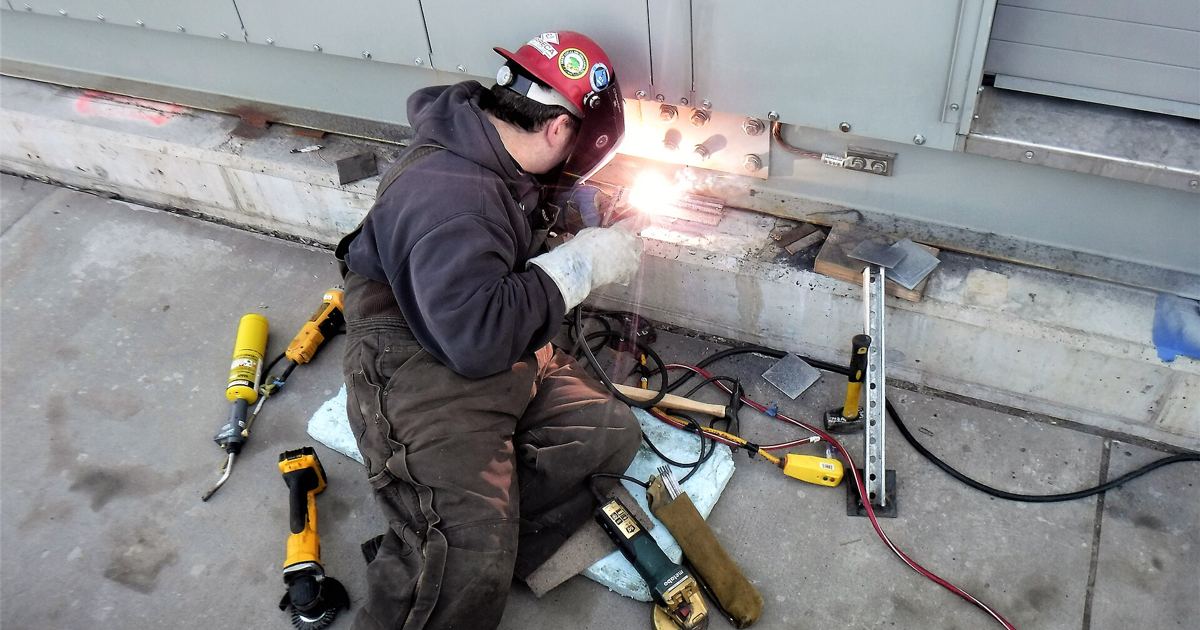
Arc welding and cutting operations create electrical and thermal hazards on active jobsites. For commercial subcontractors and estimators, compliance with federal safety mandates directly affects equipment pricing, consumable budgets, and task sequencing. Reviewing eCFR § 1926.351 Arc Welding and Cutting helps contractors understand the technical equipment rules, ground return restrictions, and operational steps required during construction bids.
What Does § 1926.351 Require for Manual Electrode Holders?
The standard establishes specific design and insulation criteria for manual electrode holders. Contractors may only use manual electrode holders that are specifically manufactured for arc welding and cutting. Furthermore, these tools must possess a capacity capable of safely handling the maximum rated current required by the electrodes in use.
To protect workers from electric shock, any current-carrying components passing through the grip portion that an arc welder or cutter holds in their hand must be fully insulated. In addition, the outer surfaces of the holder jaws must be completely insulated against the maximum voltage encountered to ground.
What Are the Rules for Welding Cables and Splices?
Welding leads take significant wear on construction sites, making strict cable standards necessary under federal rules:
- Cable specifications: All arc welding and cutting cables must be completely insulated, flexible, and capable of handling the maximum current demands of the ongoing work, accounting for the duty cycle under which the operator works.
- The 10-foot rule: Cables must remain completely free from repair or splices for a minimum distance of 10 feet from the cable end connected to the electrode holder. The only permitted exceptions are cables with standard insulated connectors or splices with insulating quality equal to that of the original cable.
- Connecting lengths: When joining cable sections together, crews must use substantial insulated connectors with a capacity at least equivalent to the cable. If cable lugs make the connection, workers must fasten them securely for solid electrical contact and fully insulate any exposed metal parts.
- Field repairs: Damaged cables requiring repair cannot be used. If regular wear exposes bare conductors on sections located outside the 10-foot lead, the exposed metal must be protected using rubber and friction tape or equivalent insulation.
How Must Ground Returns and Machines Be Grounded?
Ground return circuits must carry sufficient electrical load without creating fire hazards. A ground return cable must possess a safe current-carrying capacity equal to or greater than the specified maximum output capacity of the arc welding or cutting unit it serves. If a single ground return cable connects to multiple machines, its safe current capacity must equal or exceed the total combined maximum output capacities of all connected units.
The standard strictly prohibits using pipelines containing gases or flammable liquids, or conduits carrying electrical circuits, as ground returns. For work on natural gas pipelines, the federal regulations under Department of Transportation Office of Pipeline Safety 49 CFR part 192 apply. When using a building structure or pipeline as a ground return circuit, workers must confirm required electrical contact across all joints. The emergence of sparks, arcs, or heat at any location requires immediate rejection of the structure as a circuit.
When employing a pipeline or structure continuously as a ground return, workers must bond all joints and conduct periodic inspections to verify that electrolysis or fire hazards do not develop. Welding machine frames must be grounded through a third wire in the supply cable or via a separate wire grounded at the current source. Crews must check grounding circuits to confirm electrical resistance is low enough to allow sufficient current to trip the fuse or circuit breaker. All ground connections require inspection to confirm they are mechanically strong and electrically adequate.
What Operating Instructions Must Employers Provide?
Under eCFR § 1926.351 Arc Welding and Cutting, employers are required to instruct employees in safe operating procedures. When electrode holders will be left unattended, workers must remove electrodes and protect or position holders so they cannot make electrical contact with people or conducting materials.
Employees must never dip hot electrode holders into water, as doing so exposes workers to electric shock. When an operator leaves work, stops work for an appreciable length of time, or moves the machine, the equipment power supply switch must be opened. Crews must report faulty or defective equipment to supervisors immediately, and refer to § 1926.406(c) for additional installation standards.
When Must Welding Operations Be Shielded?
Whenever practicable, employers must shield arc welding and cutting operations using noncombustible or flameproof screens. These physical barriers protect surrounding workers and other individuals on the jobsite from direct rays emitted by the arc.
How Should Estimators Account for Compliance in Bids?
Accounting for Section 1926.351 requirements ensures that project bids reflect true field overhead rather than unexpected change orders. Estimators should verify that tooling budgets include flameproof screens and compliant, factory-insulated cable whips that meet the 10-foot clean-cable rule.
Labor schedules must allocate time for periodic ground-connection checks, structural joint bonding checks, and safe equipment shutdown protocols. These expenses are frequently accounted for within project general conditions. Estimators can also consult general trade estimating guides to ensure site safety items are distributed correctly across task proposals.
Sources
eCFR § 1926.351 Arc Welding and Cutting
Published October 28, 2026. No affiliate links on this page. Facts come from the sources linked above; check them for updates.